Breaking it Down by Speed Williams – August 2026
Back when I first started heading there were two main kinds of headers: guys who scored, caught and then set up the steer and gave good handles; then there were reachers. There were a few that could do both, but the majority were one dimensional.
Some may find this controversial, but I see people on social media teaching things that are so hard for beginners to accomplish. Let’s get into that. Roping both horns at the same time and throwing straight down is the way most of the professional headers rope now. They are throwing so fast and they’re reaching.
This is not how I teach my beginner students. I’ll use the analogy of pool players or hunters. Teaching beginners to rope both horns at the same time is like trying to people who can’t make a pool shot in the first place, how to put English on a cue ball. Or like trying to teach someone to shoot doves with a 22. When I was young, I shot many 22 shells at birds flying. A few fell out of the sky, but not usually the one I was aiming for. You must be a really good shot to go bird hunting with a 22.
When I was 13 or 14 years old, my father had me teaching people how to head. They would come spend the weekend and try a horse having never ridden or roped a steer. They wanted to become a cowboy. My job was to teach them to catch so they would buy a horse. Even though I reached and roped both horns at the same time most of the time, what he wanted was for me to teach them to catch.
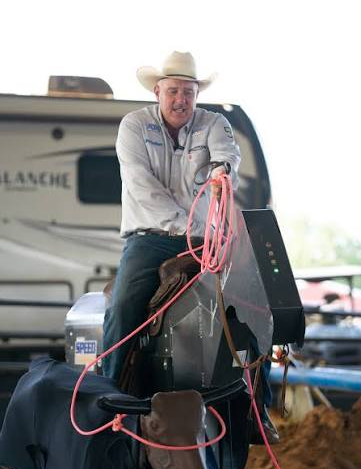
The first thing I do is run the rope out about 10 to 12 feet. I prefer roping on a horse sitting still, or the Speed Trainer, rather than a dummy on the ground. This is because you’re creating muscle memory at a correct and realistic height and angle.
A few years ago, when I was at Cowboy Christmas with the Speed Trainer, I had people climb on who had never swung a rope but wanted to learn to catch. We put them on the Speed Trainer with the steer close to them. They learned to swing about 10 or 12 foot long and swing it over the steer’s horns.
Contrary to what many teach about rolling your wrist, I don’t want your wrist to move. I want the rope to swing perfectly smooth. If you keep your hand center, you can still swing your rope in a smooth line from right to left. It should look the same on the right as the left. It shouldn’t “dance” in the air, and if it does, then you have too much movement with your wrist and your hand is moving up and down.
Once we’re able to do that, I show them how to feed their rope. We don’t start out feeding, but I want them to understand the process. All you do is move your third finger a little bit. You don’t open your hand, just release the pressure on your loop with your third finger. By doing this they understand the mechanics. It takes a little longer to teach but I want them to understand going forward.
The next step is to get on the horse with the dummy close. They swing their rope, stay still and don’t lean. Then I have them swing their rope where it’s a foot above the horns and when they deliver, they go outside the elbow to the right. You do not turn your thumb down as when reaching, but rather keep it at a 45-degree angle while delivering across the horns. Once that’s accomplished and can be done about four times in a row, we work on the release point. When you’re swinging the rope, you want to start opening your hand when it’s directly outside your right shoulder then slowly open your fingers and guide the rope across the head.
Then we work on pulling slack with your left hand going forward – up the horse’s neck. This is the most common mistake almost every team roper does the first time they catch a live steer. They move their left hand to the outside causing their horse to go left. It’s essential to learn to push your left hand forward and then dally around the saddle horn. This muscle memory is very important.
The reason I’m so adamant about beginners learning to rope right to left versus both horns at the same time is because most beginners are going to be entered in the #6, #7 or #8 ropings where the cattle will probably be older and slower with big horns and have a few head tricks.
It’s a higher percentage shot to throw a “cast net” on than to throw straight down over your elbow with a lot of slack between your hands. The problem with roping both horns in a lower number roping is often you’ll figure-eight front legs, split horns or wave it off because your loop is usually big. You cannot be successful reaching right to left. Any time the steer is more than 12’ from you I recommend roping both horns at the same time.
But my beginners have to learn to rope right to left because they have to ride a horse to position trying to stay on top of him, not fall off, and still catch the steer. I don’t see it happen very much but one thing I recommend for beginners learning is to figure out what loop size you want, have one coil and the tail hanging down within 12” of your stirrup. This makes you accountable when you catch the steer and will make you stay with him and able to get your dally.
Years ago, Rich and I taught a school while we were in Guymon, OK. I don’t remember the names and details, but all week I’d heard that I would have a difficult student, and they were waiting to see how I handled him.
He was the boss and the one paying for most of the people at the school. He was the grandfather to many and this was his party. I believe there were 15 headers and 15 heelers. He reminded me of my father, a crusty old cowboy. The first steer he ran and roped, he went left and missed his dally two or three times. He got it at the knot and jerked the steer. I rode up and said, “I understand you’re the boss, but I’m going to give you one more chance to rope and get your dally and then I’m going to fix you.”
He said, “Son, many have tried, but that is the way I rope.” I told him he had one more chance. Well on the next steer he roped and ducked, it was wild. I rode up and asked for his rope and I cut it off short, very short. He looked at me and said, “Well hell, nobody’s ever done that to me before.”
For the next two days he would run up to the steer and rope. On the first one, the whole arena whooped and hollered “He showed you!!” His answer was, “I have no rope, I have to ride my horse.”
With that short rope, it’s mental. When you throw you have to keep riding. Both of my kids roped with just one coil until they were #5’s. I have shaken hands with so many young people with missing digits. Learning to rope with one coil teaches them to ride their horses better.
I have taught many beginners to rope. It doesn’t take long to get someone to catch when they’re roping right to left. We all want to learn to rope both horns at the same time, especially if you want to go fast. But, roping right to left really comes in handy when you’re high call and have eleven seconds to win. Your success ratio can be very high.
There are quite a few ropers who have been very successful in their career who also teach people to rope. I recommend getting advice from someone who has had success, and their theories have been proven in the arena. Getting wrong advice, however well intentioned, could set your roping back two or three years and cause you quite a struggle.